

SOCCER SYSTEMS OF PLAY
©CoachingAmericanSoccer.com®
A system of play in soccer is the total strategic and tactical approach on the part of a coach and an organization that guides the team on the field. It is comprised of a coordinated set of principles, player roles, movement patterns, and decision-making rules that govern how the team is expected to perform. This includes how the team attacks, defends, transitions, and adapts throughout a match, utilizing a formation that is the team’s general spatial arrangement within that system of play.
In different terms, a formation, therefore, is a component within a system of play and does not represent the overall system of play itself. Often, the term “formation” is substituted imperfectly to mean “system of play.” A system of play is much more than a formation. While a formation identifies where players are generally grouped on the field, a system of play defines how the team actually plays the game. It is the complete blueprint that is intended to guide players’ decision-making in every phase of a match. It establishes the team’s identity, dictates player responsibilities, and provides the principles that allow individuals to perform as a unified team.
Think of the formation as the basic design of a house while the system of play is everything that makes the house functional—its structure, electrical system, plumbing, HVAC, interior features, and the way people actually move about and live inside it. Two teams may both line up in a 4-3-3, yet one may emphasize patient possession, and the other relentless high pressing and rapid counterattacking. The formation remains the same, but the systems of play are completely different.
As an elemental example, those two different teams both running a “4-3-3” formation may have a significantly different approach to how the three forwards operate. Team A may use a front line with a leading center striker and traditional wings, all three of whom often make runs forward-and back, as indicated below:
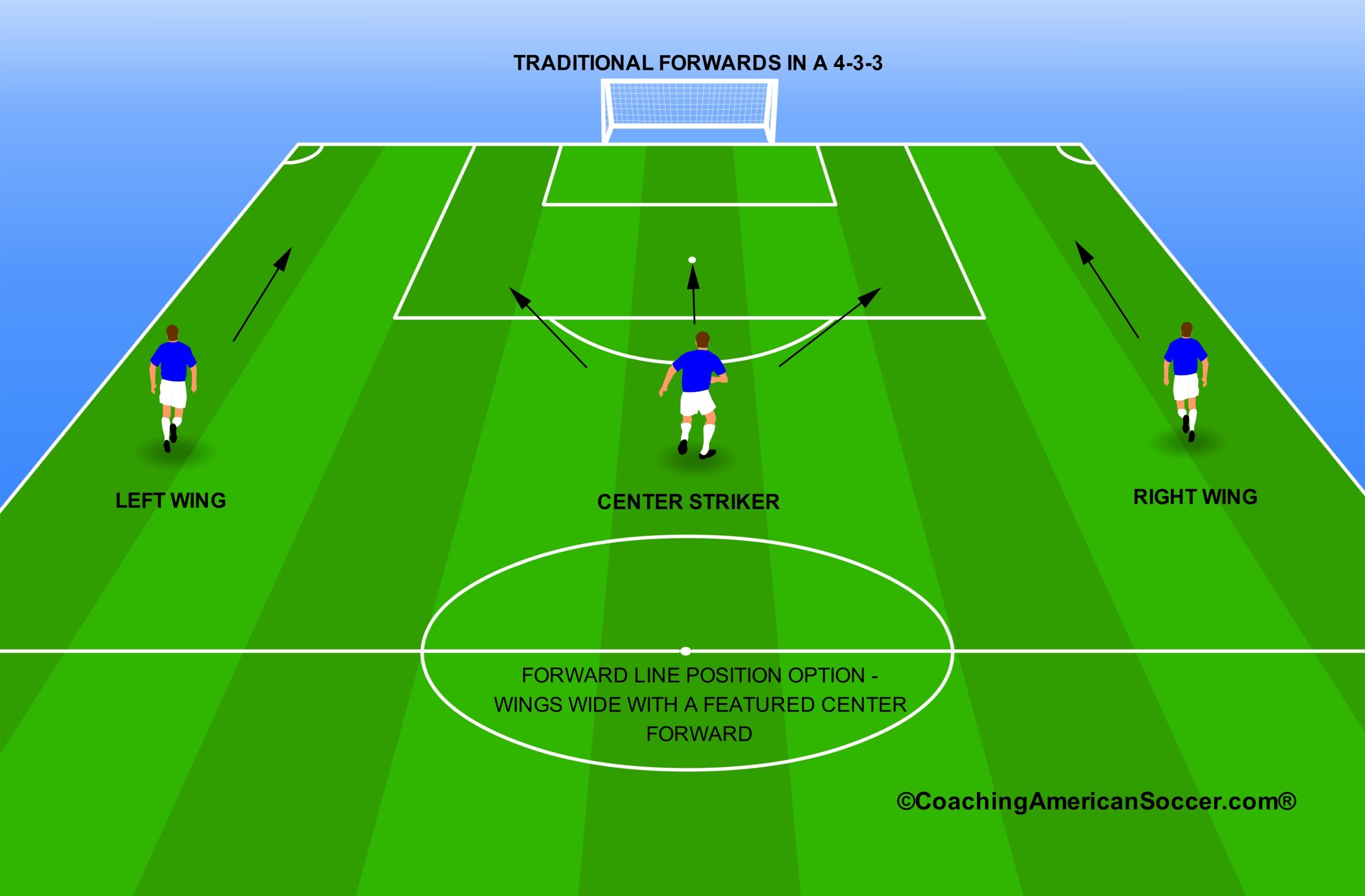
Placement of Traditional Soccer Forwards in a 4-3-3 Formation
Team B may use a front line with a set-back center striker and two inside forwards, with the two insides running on diagonals into open space on the flanks and the center striker moving into open space freed by the runs of the forwards, as indicated below:
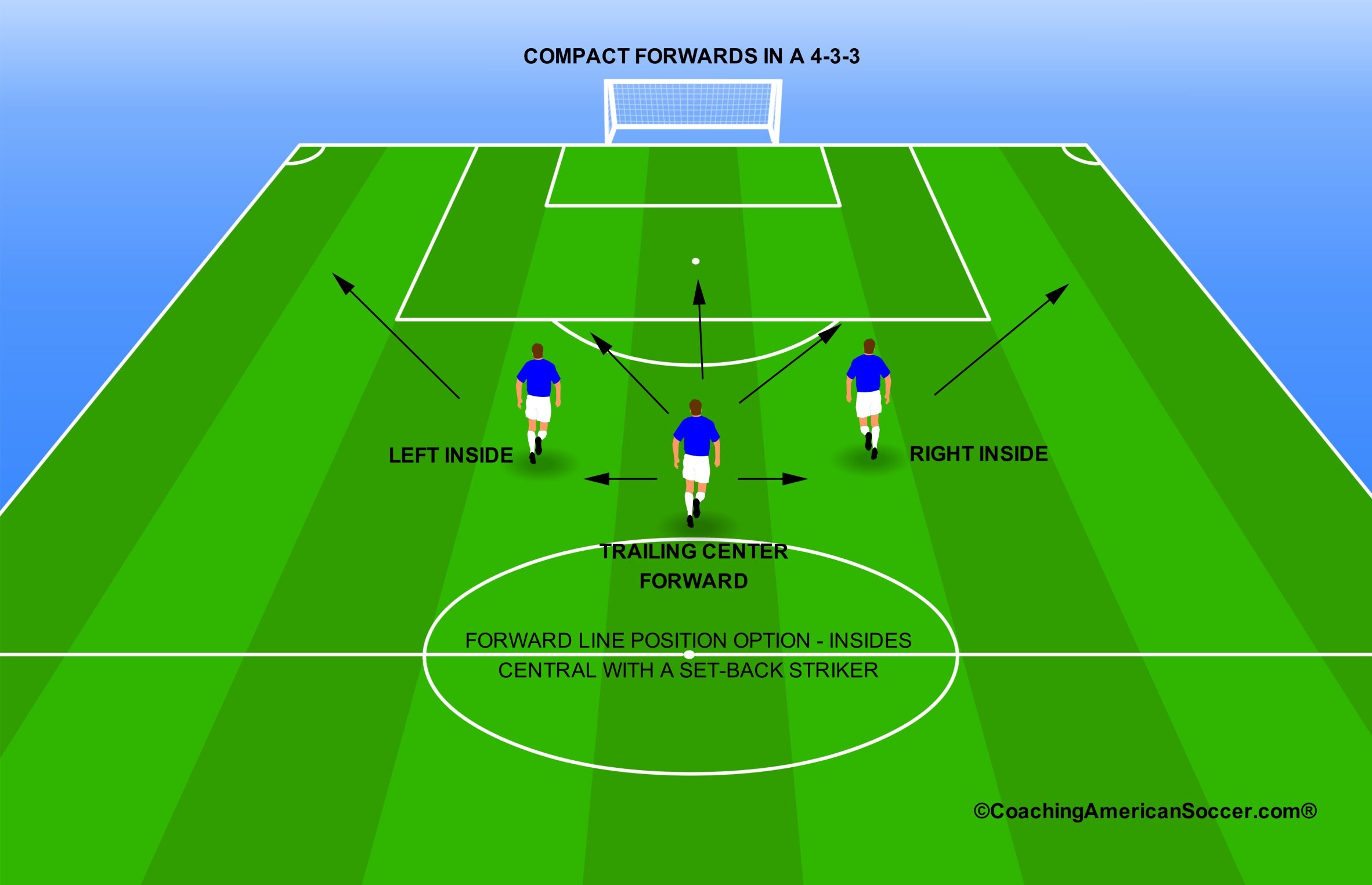
Compact Forward Line in a Soccer 4-3-3 Formation
In both cases the teams are using a “4-3-3” formation, but the play of the forward line is significantly different as the players execute a portion of the overall system of play designed and implemented by the coach and the coaching staff.
More broadly, these same two teams, running a “4-3-3” formation, may play under significantly different tactical principles which constitute parts of their system of play. For example:
Team A’s tactics
- Mid-block defense
- Defensive back line at the top of the defensive third
- Possession-based buildup
- Fullbacks invert into midfield
- Wing forwards stay wide
Team B’s tactics
- High-block defense
- Defensive back line near midfield
- Direct counterattacking
- Fullbacks overlap aggressively
- Wing forwards are insides
In summary, a soccer system of play is the total tactical framework that brings a strategy to life. While a formation dictates a team’s basic structural shape, a system of play defines the specific roles, attacking and defending behaviors, and positional transitions of each player. In other words, a system of play is the coordinated set of tactical principles, player roles, movement patterns, and decision-making rules that govern how a team attacks, defends, transitions, and adapts throughout a match. The formation is simply the team’s initial spatial arrangement within that system.
Comparison
Formation System of Play
Basic shape Detailed tactical model
Players’ general locations Players’ roles and responsibilities
Fixed Dynamic
Lines Movement
Establishing a system of play requires implementing a number of basic elements, including the formation, the style of play, individual player abilities, and situational play.
The Formation
Formations are typically identified by the number of players in each line from back to front (defenders, midfielders and forwards. With the goalkeeper assumed). The arrangement dictates the starting positions and relative locations of the players to one another. The formation may be determined in advance by the coach, but more often it is based, first, on the age group involved, and then on the abilities of the players.
U.S. Youth Soccer recommends formations based on age groups:
U6 to U8 (4v4) (no goalkeeper)
- 1-2-1 (Diamond): One defender, two wide midfielders, one forward.
- 2-2 (Box): Two defenders and two attackers.
U9 to U10 (7v7) (adds goalkeeper)
- 2-3-1: Two defenders, three midfielders, one forward. This shape gives great width and central coverage.
- 3-1-2: Three defenders, one central midfielder, two forwards. Good for balancing defensive stability with an attacking threat.
U11 to U12 (9v9) (with goalkeeper)
- 3-2-3: Three defenders, two central midfielders, three forwards (winger/striker/winger).
- 3-3-2: Three defenders, three midfielders, two forwards. Offers strong control of the middle third.
U13 and Above (11v11) opens up an incredible variety of options and descriptions:
- 4-3-3: A traditional, possession-oriented structure that allows for high pressing and balance between attack and defense.
- 4-4-2: A more defensive structure providing midfield control and transition, featuring creative, paired strikers.
- 4-2-3-1: An adaptable and fluid structure that creates midfield flexibility in both defense and attack and featuring a dynamic central striker.
Formations should not be determined in a vacuum. A formation should fit the players’ strengths and weaknesses and the players must understand and be comfortable in the formation. Players should not be force-fit into a formation – the formation should accommodate the players.
Individual Player Abilities
Age, maturity, physicality, endurance, skill level, size/height, overall strength, soccer IQ, speed, quickness, work rate, knowledge of the game, tactical awareness, control, and experience all come into play when determining the best fit in a formation.
Player Evaluations
Who wants to play defense. Who wants to play offense. Who wants to play midfield, and who is good at each. Who regularly stops opponents. Who will not be denied to score a goal. Who seems indefatigable.
Player Training
Of players with missing skills, who can be coached to raise their skill level.
Player Understanding
Of players with missing tactical sense, can they achieve the next level of performance with appropriate instruction and repetition.
Goalkeeper(s)
Who wants to play goalkeeper. Who is good at it. Who has the temperament. Do you have at least two. Can you use a rotation.
Style of Play
The coach determines the overall philosophy of how the team is expected to perform when out of possession (on defense), upon winning the ball (in transition from defense to offense), when in possession (on attack), and upon losing the ball (in transition from offense to defense). This includes such choices as:
Defense: Man-to-Man, Zone or a combination, Flat-Back or Diagonal, Stopper-Sweeper.
Pressing: Low-Block, Mid-Block, High-Block, (Cover/Pressure/Balance).
Midfield Play: Building from the back, Creating a numerical advantage, Retaining possession, Quick counter attack.
Attack: Direct, Indirect, Runs, Flanks (wings), Crossing, Shots from distance, Airborne balls.
Possession: Circulation, Use of the Goalkeeper.
Player Roles and Responsibilities
A system of play assigns specific tasks to players based on their positions and the formation. An effective system of play gives every player answers to the game’s most important tactical questions, such as:
- What do we do when we win possession?
- What do we do when we lose possession?
- How do we defend?
- How do we attack?
- How do we transition?
- How do we solve problems when the opponent changes tactics?
When every player understands the answers, the team becomes organized, predictable to its teammates, and difficult for opponents to break down.
Defining Positional Responsibilities
Every player must understand responsibilities that extend far beyond a simple field position. Each position should include:
Technical Responsibilities
- Passing expectations
- Receiving techniques
- Finishing requirements
- Tackling ability
- Aerial play
Tactical Responsibilities
- Positioning
- Decision making
- Movement
- Communication
- Reading the game
Physical Responsibilities
- Running demands
- Sprint frequency
- Recovery ability
- Endurance
- Strength requirements
Psychological Responsibilities
- Leadership
- Confidence
- Discipline
- Composure
- Competitive mentality
- Performance under pressure
Every player should understand not only what to do individually, but also how his responsibilities connect with teammates. For example:
Strikers: Traditional wing or center-striker play.Holding Midfielder: Sits in front of the center-backs to break up opposing attacks and distribute passes.
Center Midfielder: Provides support in both defense and attack, carrying the ball forward. Ability moving “box-to-box.”
Attacking Midfielder: The creative strategist who dictates tempo and unlocks the opponent’s defense.
Wing Backs: An outside back may invert, overlap, or stay home depending on the system.
Goalkeeper: Last line of defense, first line of attack.
Communications (both oral and non-verbal)
Every system depends upon clear oral communications. A proper, shared vocabulary allows rapid decisions under pressure. For example, the coach establishes common terminology for:
- Pressing
- Pressure, Cover, Balance
- Switching
- Dropping
- Holding possession
- Turning
- Delaying
- Recovering
- Shooting
Further, common non-verbal communications should be established. These include such signals as:
- Identifying selection of a corner kick play.
- The start of a set-piece free kick
Game States
Defining a system of play also means understanding how the shape changes depending on the phase of the game. For example:
Attacking Phase: The system might push fullbacks high up the field and insert midfielders.
- Recovery runs
- How possession is built from the back
- How space is created
- Run patterns
- Maintain width and depth
- Create depth
- Support
- Switching the point of attack
- Penetration
- Maintain possession when penetration is unavailable
- Create numerical superiority around the ball
- Move immediately after every pass
- Preferred methods of building from the goalkeeper
- Passing patterns
- Player movement
- Final-third combinations
- Crossing philosophy
- Shooting opportunities
- Risk management
- Possession
Transition to Attack
The instant possession is won often presents the greatest scoring opportunities. The coach determines:
- Counterattack patterns
- Whether to counterattack immediately
- Whether to secure possession first
- Which players sprint forward
- Which players provide support
- Which players remain behind the ball for protection
Transition to Defense
Perhaps the most important few seconds in soccer occur immediately after possession is lost. The coach establishes:
- Immediate counter-press or retreat
- Counter-pressing responsibilities
- Recovery positioning
- Delay tactics
- Compactness
- Defensive communication
- Protection against immediate counterattacks
- Upfield defensive coordinator
Defensive Phase: Drop into a base formation. Support in defense.
- Pressing strategy
- Defensive block height
- Compactness
- Marking responsibilities
- Immediate pressure on the ball
- Cover behind the first defender
- Defensive balance
- Compact team shape
- Protect central areas
- Delay when immediate pressure is impossible
- Force play toward predetermined areas
- Win the ball collectively rather than individually
- Pressing height
- Defensive line lockup location
- Compactness
- Defensive triggers
- Protecting dangerous spaces
- Recovery runs
- Collective defending
- Goalkeeper as defensive coordinator
Positional switches: Which players are likely to exchange positions and when.
Adjustments: How the team changes when leading, trailing, playing short, or playing with a numerical advantage.
Modifications based on opponent or conditions: Analyzing and addressing the strengths and weaknesses of both one’s own team and the opponent; self-scouting and opposition scouting. Changing tactics based on rain, wind, a wet or dry field, natural grass or artificial turf. Making the changes accordingly.
Establishing Team Shape
A system of play requires recognizable team shape in every phase. The coach defines:
- Vertical compactness
- Horizontal compactness
- Team depth
- Team width
- Distances between lines
- Distances between individual players
- Height of the defensive line
- Height of the midfield line
Well-organized spacing allows the team to attack efficiently while remaining prepared to defend.
Developing Functional Relationships
Players never operate independently, in the sense that every action has an impact on the whole team . As such, coaches should teach relationships between players. Examples include:
- Center back and outside backs
- Outside backs and wings
- Dual center backs
- Defensive midfielder and center backs
- Holding midfielder and attacking midfielder
- Two central midfielders
- Center forward and supporting attackers
- Goalkeeper and back line
These partnerships allow players to anticipate each other’s movements without verbal communication.
Building Patterns of Play
Systems become recognizable through repeated patterns. Examples include:
- Building out from goal kicks
- Breaking high pressure
- Overlapping runs
- Underlapping runs
- Third-man combinations
- Switching play
- Creating overloads
- Counterattacking sequences
- Crossing patterns
- Finishing combinations
Patterns are not rigid plays but rehearsed solutions that help players recognize common game situations and how to react to them.
Establishing Pressing Triggers
Pressing should never be random. Effective systems define specific moments when pressure begins. Common triggers include:
- Poor first touch
- Backward pass
- Square pass
- Pass into a wide channel
- Receiver facing own goal
- Slow goalkeeper distribution
- Isolated defender
- Poor supporting angles
When every player recognizes these triggers simultaneously, pressing becomes coordinated rather than chaotic.
Defining Defensive Block
The coach determines where the team prefers to start to defend. Examples include:
- High block
- Mid block
- Low block
Within each block, players must understand:
- Line of confrontation
- Pressing intensity
- Defensive compactness
- Recovery responsibilities
- Counterattack opportunities
Attacking Philosophy
Every system should answer several fundamental attacking questions. These may include:
- How does the team build attacks?
- Where are overloads created?
- How is width maintained?
- How are defenders unbalanced?
- When should possession be recycled?
- When should players attack vertically?
- When should players dribble?
- Who joins the attack?
- How many players remain behind the ball?
Clear answers reduce hesitation and improve collective decision making.
Defensive Philosophy
Likewise, every defensive system should define:
- Where pressure begins
- Which spaces receive priority
- Which passing lanes are denied
- How crosses are defended
- How set pieces are defended
- Recovery expectations
- Communication standards
- Organization after losing possession
Great defensive teams defend with organization long before individual tackles become necessary.
Set Pieces and Re-Starts
A complete system of play addresses all dead-ball situations, on both offense and defense, and in all locations on the field. These include, but are not limited to:
- Corner kicks
- Free kicks
- Throw-ins
- Goal kicks
- Penalty kicks
- Kickoffs
- Walls
- Dropped ball
Each set piece should contain organized responsibilities, rehearsed movements, and contingency plans.
Addressing All Soccer-Specific Options
In addition to all of the above, coaches need to address all other aspects of the game. These include, but are not limited to the following: (Not a complete list; No order is implied.)
Defending free kicks without a wall
Using an offside trap
Beating an offside trap
Outlets
Attacking and defending fast breaks (quick counters)
Substitutions
Responding to opponent’s choice of defensive block
Reacting to field conditions
Responding to added time/extra time/injuries
Captain’s responsibilities
Mods due to specific opponents (scouting)
Attacking style: long ball, possession, short passing, counter attacking
Through balls, chips, crosses, long shots, use of 1v1, centering
Marking someone out
Double-teaming
Drawing a team out
Emergency defending
Use of #9, False 9, front runners
Changes due to field size
Flat-front forwards
Air game, attack and defense
Giving ground; when to stop giving ground
Poaching (player freedom to…)
Individuality, individual initiative; encouraging creativity (or not…)
Behavior (decency; spirit and intent of the Laws)
Slashing (diagonal) and/or straight runs
Use of space
Penalty kick tiebreakers
Killing the game
Long game; short game; combo
Passing midfielder; defensive midfielder; attacking midfielder; holding midfielder
Playing from behind
Playing with a lead (or a big lead)
Types of runs
Use of a playmaker
Specific game changes to a system of play
Within-game changes
Shooting (range; opportunities…)
Sitting back
Varying the attack
Use of a professional foul
Finding the free and open man
Match Management
A mature system prepares for changing match conditions. Players should understand adjustments when:
- Leading late
- Trailing late
- Playing short
- Playing numbers up
- Facing different formations
- Protecting a lead
- Chasing a goal
- Managing fatigue
- Managing momentum
- Changing formations within a game (for greater offense or greater defense)
- Killing the game/Running out the clock
Rather than abandoning the system, successful teams make controlled tactical adjustments within it.
Training the System
A system of play is never installed during one practice. It develops progressively through repetition and increasing complexity over time. A logical progression includes:
- Teach individual positional responsibilities.
- Develop relationships between small groups of players.
- Train units such as defenders, midfielders, and forwards.
- Integrate the entire team.
- Introduce opposition.
- Rehearse attack, defense and transitions between the two.
- Practice match-specific scenarios.
- Evaluate performance through video and match analysis.
- Refine details throughout the season.
Every training activity should reinforce one or more components of the team’s system and build upon previous installments. Players learn systems by repeatedly solving realistic game problems rather than by memorizing diagrams.
Adaptations
No system remains static. Opponents, player availability, weather, and match situations all require adjustment. The best systems are flexible enough to adapt while preserving the team’s core principles. A team may defend deeper against a stronger opponent or commit more players forward when going for goal, but its fundamental identity—how it attacks, defends, and transitions—should remain recognizable.
This balance between consistency and adaptability distinguishes accomplished teams from merely organized ones.
Summary
A complete soccer system of play is the tactical framework that transforms a collection of talented individuals into a cohesive team. It defines far more than where players stand on the field. It establishes the team’s identity, organizes every phase of the game, clarifies individual and collective responsibilities, and provides a common tactical language that guides decision making.
The most successful coaches do not simply teach formations – they build systems. They carefully define principles of play, train positional relationships, rehearse attacking and defending patterns, prepare for transitions, organize set pieces, and cultivate the flexibility to adapt without sacrificing identity. When every component works together, players no longer react independently to the game. Instead, they think, move, and solve problems as a coordinated unit. That unity is the true hallmark of an effective system of play and the foundation upon which consistent, successful soccer is built.
Soccer Coaching Tips:
- See: Positions , Positions Numbers , Initially Placing Players in Positions , Introduction to Formations , and Formation Pathways.
- Use all of the items listed in the article above as a check-list to ensure that you have introduced, installed, implemented, trained, and practiced the numerous aspects of the game.
- See Conducting a Controlled Scrimmage (Future article)
© Copyright, John C. Harves