

ADVANCED CROSSING IN SOCCER
© CoachingAmericanSoccer.com®
A cross in soccer is usually a medium- to long-range pass generally kicked from a wide area of the field near the sidelines into an area in front of the opponent’s goal to create a scoring chance for a teammate. Crosses are more than often airborne, but can also be made along the ground. Crosses are governed by the same things that govern any good pass: accuracy, timing, weight, direction, and a full awareness of where the intended receiver is going. A perfectly struck ball that no attacker can reach is not a good cross. A modest ball that arrives exactly where a teammate can finish it may be an excellent one.
As with any pass, a cross is not simply a ball kicked in the general direction of the goal. It is a deliberate service designed to arrive at a particular place, at a particular height and speed, at a particular moment, for a particular teammate. Although the majority of crosses tend to be used on offense in the final third of the field, crosses may also be made to space, to set up passes to players in better positions, to retain possession, or to change the point of attack.
The best crossers understand a simple principle: the ball and the attacking player must arrive in the same place at the same time. Not only must the player get the body properly positioned behind the ball and plant the non-kicking foot correctly, but the player must also select a target before ever striking it. The service should be kept away from the goalkeeper whenever possible.
This understanding begins by recognizing that crosses have two major aspects: how the ball travels, and where the ball is going. The value of every cross depends entirely on where the crosser is standing and where the attackers are running. The complete skill of crossing requires addressing both. There is a time and place to use each type of cross. Knowing when and where to use a certain cross often comes with experience and repetition.
Modern soccer generally recognizes six principal service types of crosses: the inswinging, outswinging, driven, lofted, cut-back, and opposite field. Other common terms, such as near-post, far-post, the “18-cross,” the “12-cross,” the “6-cross,” the lead cross, and the half-space cross, describe less of the flight of the ball but more of its destination. Coaches need to keep this distinction clear, and then use the terminology consistently associated with each type of cross.
Receivers may have to delay their runs in order for crosses to materialize so that they do not overrun the flight of the ball. Since many crosses are airborne, they often result in headers by the receiver. Accordingly, a possible delay in the run may allow for proper contact to be achieved by allowing for a slight drop in the height of the ball.
Inswinging Cross
An inswinging cross, commonly called an “inswinger,” curves toward the goal as it travels across the penalty area. The ball begins outside the target area and bends inward, so that it is moving toward goal at the same moment the attackers are moving toward it. This double motion is what makes the inswinger dangerous, and it is also what makes it difficult for a goalkeeper to judge. The kicker needs to allow for the distance of the bend, however, in order to keep the ball from simply being caught by the keeper. Accordingly, the initial strike of the ball needs to be directed farther away from goal.
For the inswinger, a player crossing from the left side of the field, can strike the ball with the inside/instep of the right foot and impart the sidespin needed to bring it toward the goal. (At the highest levels, this kick could also be made with the outside/instep of the left foot.) The opposite is also true, a player crossing from the right side of the field can strike the ball with the inside/instep of the left foot to impart the sidespin necessary. (At the highest levels, this kick could also be made with the outside/instep of the right foot.)
Just because it is listed first, the inswinger should not automatically be regarded as the “best” cross. The choice of any type of cross to be used is determined by the location of the kicker and the receiver and the circumstances of play. This cross tends to be delivered from closer to the sidelines and deeper toward the endlines. The receiver, in turn, should be taught not simply to wait for this kind of service but to attack the ball aggressively in flight, because the ball is moving away from their run.
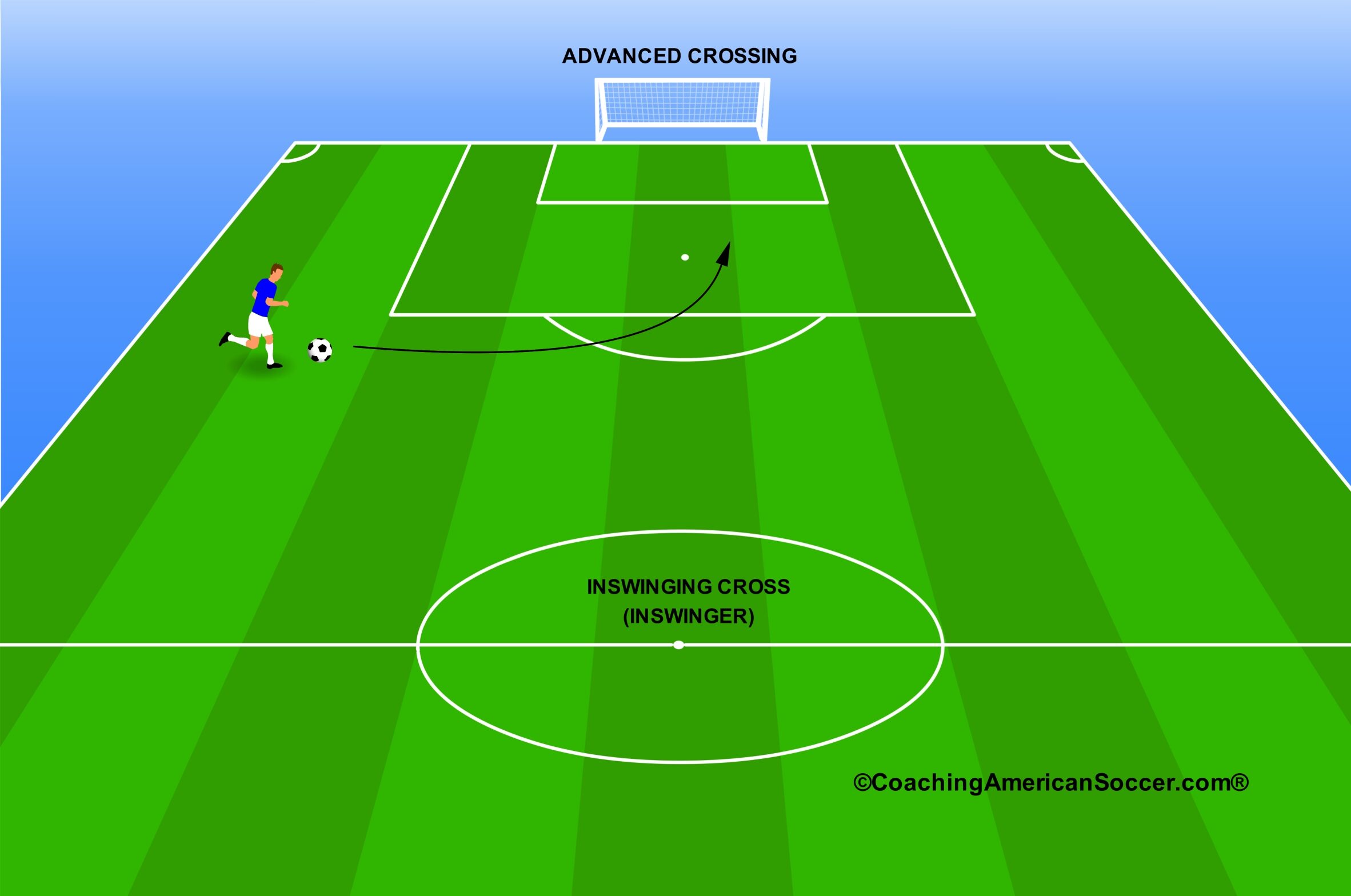
Inswinging Cross
Outswinging Cross
An outswinging cross, or “outswinger,” curves away from the goal and away from the goalkeeper as it travels through the area. The principal advantage of the outswinger is that it can be delivered into the path of an approaching attacker without bringing the ball toward the goalie. The kicker needs to allow for the distance of the bend, however, in order to keep the ball from going out into the field past the runs of the attackers. Accordingly, the initial strike of the ball needs to be directed closer toward the goal.
For the outswinger, a player crossing from the right side of the field can strike the ball with the inside/instep of the right foot to impart the sidespin necessary. (At the highest levels, this kick could also be made with the outside/instep of the left foot.) The opposite is also true, a player crossing from the left side of the field can strike the ball with the inside/instep of the left foot and impart the sidespin needed to bring it away from the goal. (At the highest levels, this kick could also be made with the outside/instep of the right foot.)
The receiver, in turn, needs to be taught that this cross is the most common case of possibly having to delay their run in order to not overrun the path of the ball.
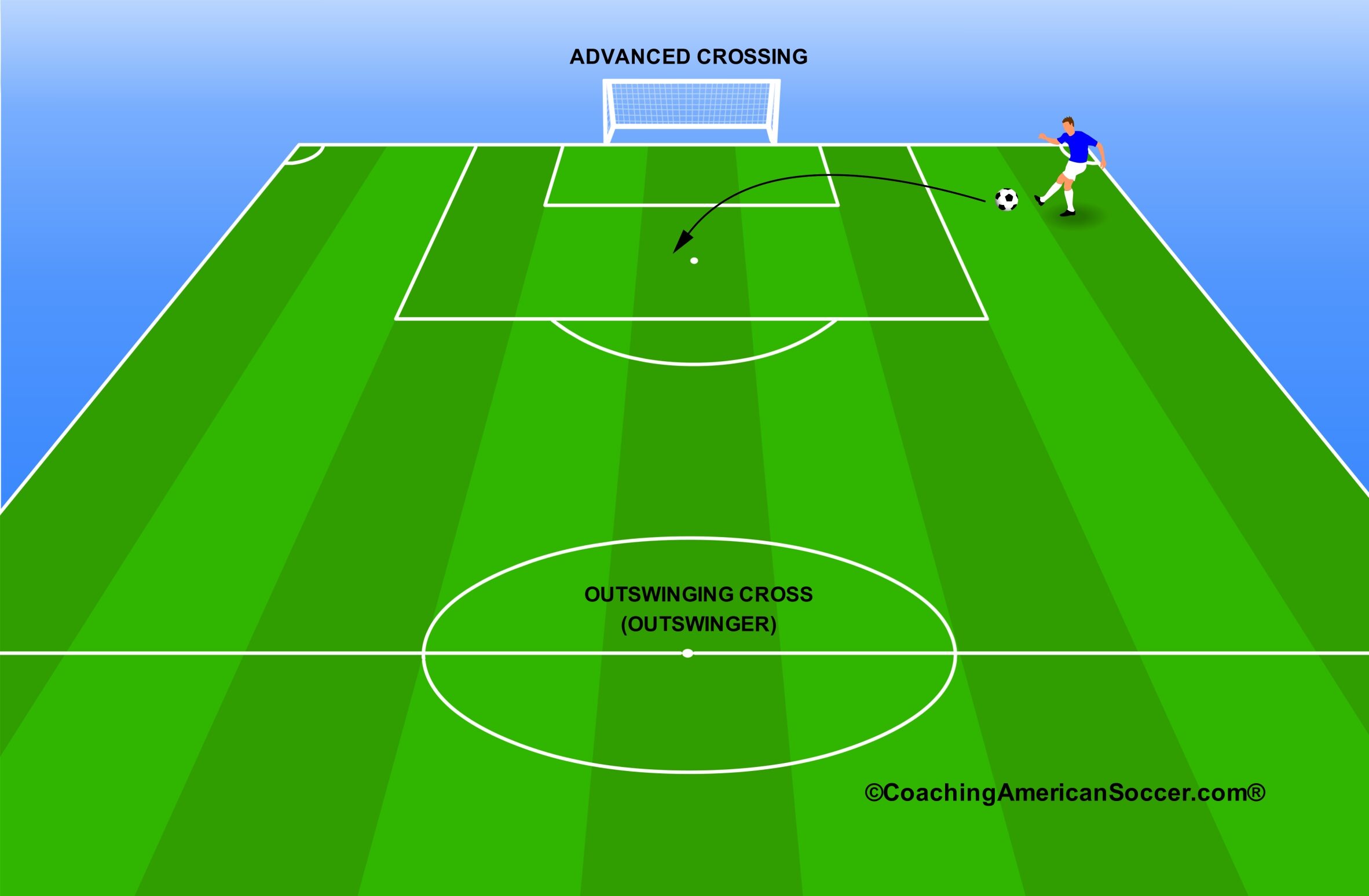
Outswinging Cross
Driven Cross and Low-Driven Cross
A driven cross is a fast, powerful pass usually sent from wide into the penalty area with a straight trajectory, often played along the ground. In comparison, a low-driven cross is equally hard and straight but travels through the air, often at waist-level or below and rarely above head-height. The purpose of both types of this cross is to make the ball difficult for defenders and the goalkeeper to intercept, combining speed and accuracy. The objective, however, is not maximum power but maximum effectiveness. The pass must get to the target player quickly without allowing time for a defender to intercept.
The ball is to be struck hard, almost always using an instep drive. The trajectory is to be straight, either on the ground or flat and low, rather than in a high, looping arc. The aiming point is most often in the space between the opponent’s goalkeeper and the back defenders, often between the top of the goal area and the penalty mark, across the face or mouth of the goal. The objective is to provide the intended receiver with a first-time or one-touch shot.
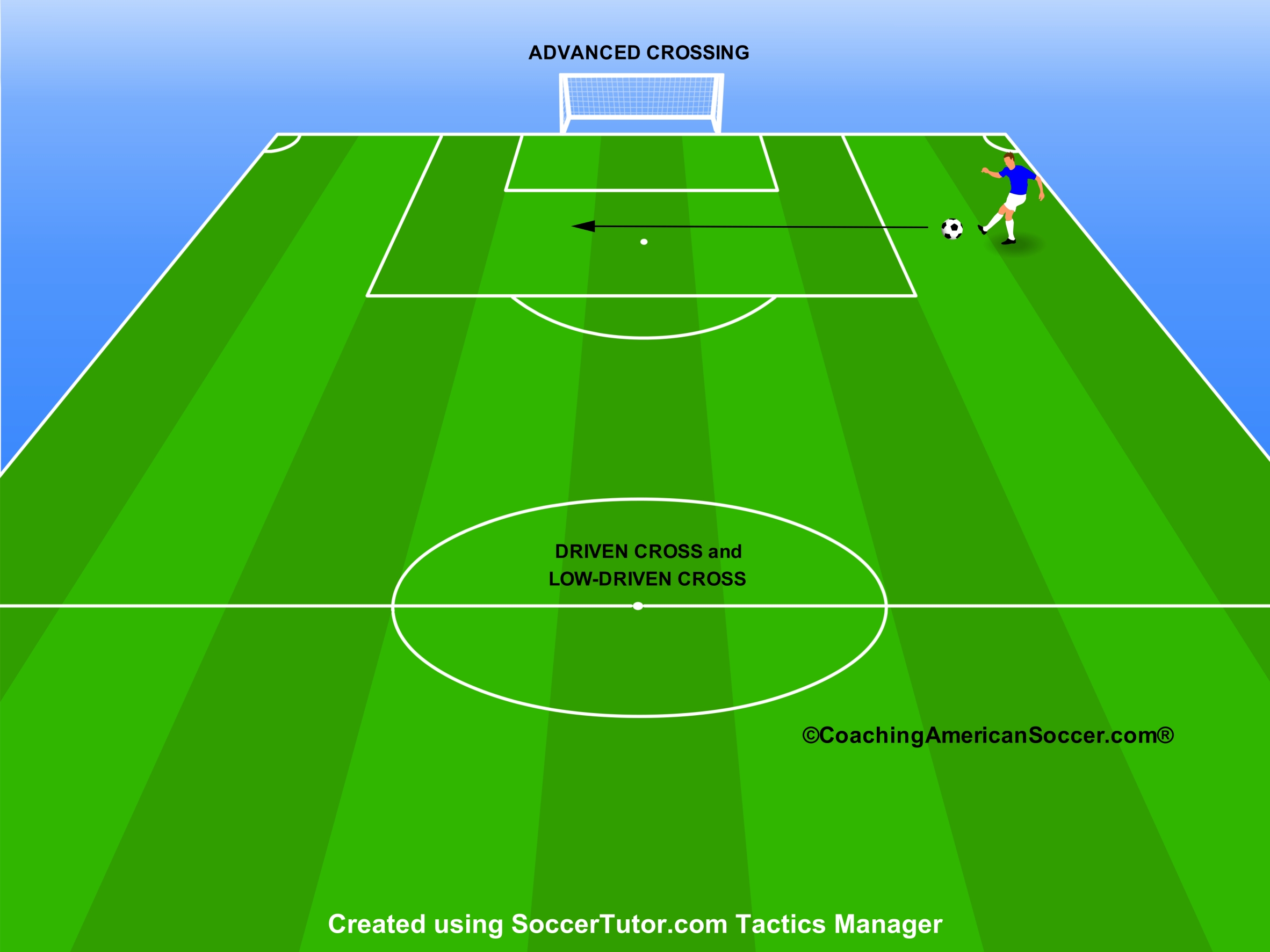
Driven Cross and Low-Driven Cross
Lofted Cross
Where the driven cross emphasizes speed, the lofted (or floated) cross requires height, distance, and time. It is commonly used to reach an attacker at the far post (or beyond) or to place the ball over a deep defensive line. As with a number of crosses, the lofted cross requires that the kicker get their hips turned toward the target before striking the appropriate portion of the ball with the instep or instep-face of the shoe.
The objective of the lofted cross is not simply to get the ball airborne, it is to get the ball just high enough and deep enough to clear the defense while still allowing the attacker to arrive and finish. Any additional height on the ball may allow defenders to recover in the amount of time required for the ball to come down. Accordingly, the height placed on the ball should actually be as low as possible and it should be placed into as open an area as possible. Similarly, the ball must be placed far enough away from the goalkeeper so that they are not able to catch it or punch it away. A ball that is too high (floated too much) is not usually very effective.
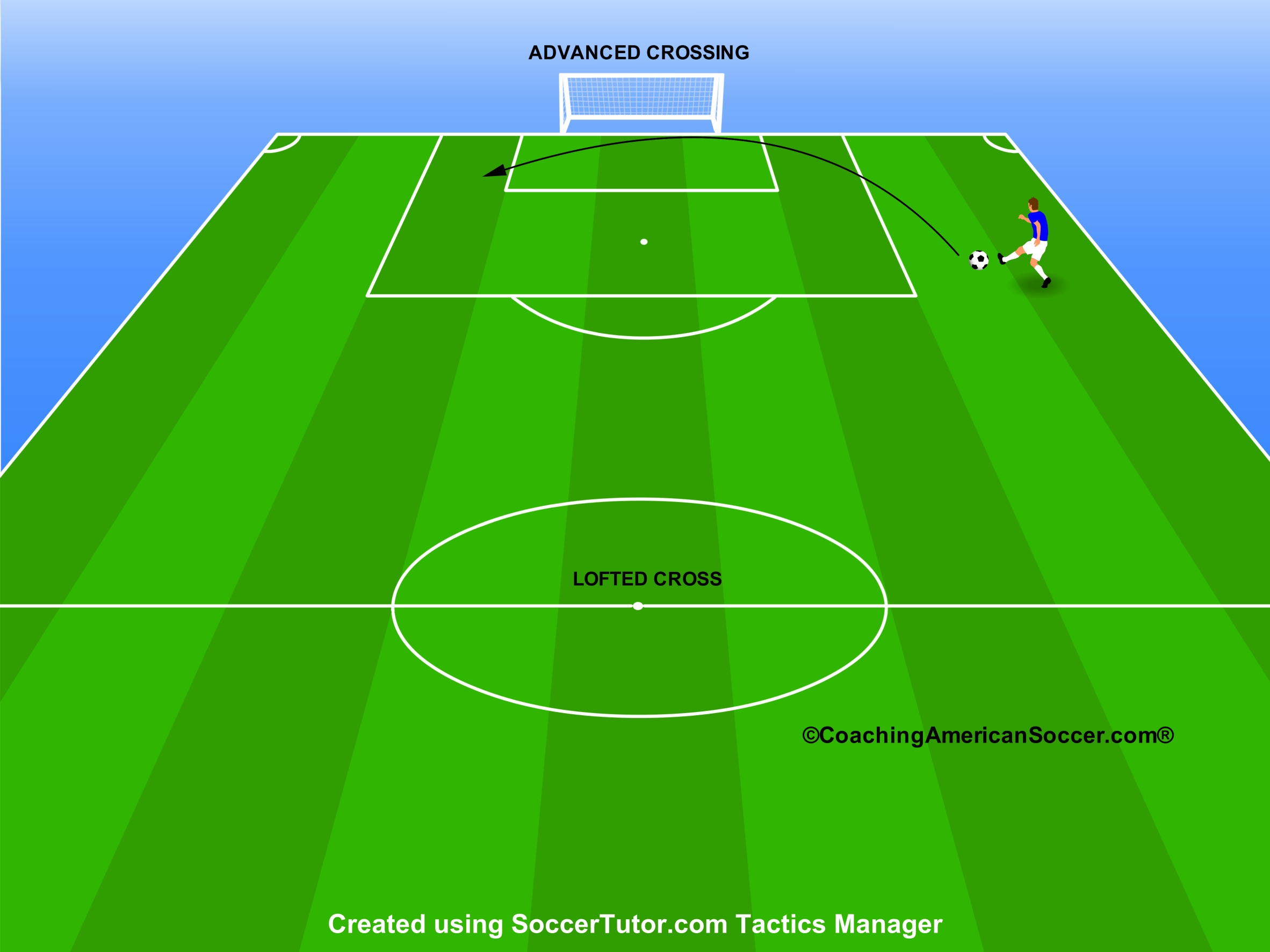
Lofted Cross
Cutback Cross or Endline Cross
A cutback or endline cross in soccer is an attacking pass played diagonally backward from near the goalline (endline or byline) to a teammate arriving in the central penalty area. A winger or attacking player dribbles the ball down the flank and reaches the endline. Instead of lofting a high cross blindly into a crowded box, the ball carrier cuts inside and faces directly along the endline. The kicker then adjusts their hips and sends the ball back against the direction of momentum. The attacker can immediately cross the ball or, if there is no defender near if the defender has been beaten, dribble along the endline toward the near post. The ball is then typically passed or driven hard and low along the ground generally between the top edge of the six-yard box and the penalty mark, across the mouth of the goal.
The action of cutting and facing the goal draws immediate attention, forcing defenders to focus on. and move in the direction of, the ball carrier, often drawing a defender away from the goal and the goalkeeper to the near post. The cutback or endline cross often produces high-probability, first-time shots with the feet, rather than difficult headers, by an onrushing teammate. Sending the ball backward allows a shooter to face the entire goal.
Opposite-Field Cross
An opposite-field cross (far cross or switching-play cross) is a long-range pass hit from one side of the field to the far side of the field. The crosser deliberately lifts the ball over the midfield defenders to find a teammate, usually a wing halfback or a late-running fullback, at the opposite sideline. Because the pass is airborne for an extended period of time and covers a long distance, the most important feature of this cross is that the receiver has the time and space necessary to collect and control the ball when it arrives.
Leading, First-Time, Early and Half-Space Crossing
Most crosses are leading crosses. A leading cross is played not to where the intended receiver is standing, or from where they begin their run, but to where they will be when the ball arrives. This is an important concept for young players to learn, since it reframes crossing as passing to the space where the teammate is going to be at the end of the flight of the ball. A first-time cross, delivered without a controlling touch, trades technical difficulty for surprise: it can beat a recovering defender and increase the speed of the attack, but it demands that the kicker judge the incoming ball and still produce an accurate service in one motion. An early cross, played from farther out than the traditional crossing zone, offers a similar trade: it can catch a retreating defense before it organizes, at the cost of a longer and therefore more difficult delivery.
A half-space cross is more like an airborne through ball with a bend at the end. It is delivered upfield from an area inside either of the two vertical channels of the pitch, located between the central corridor and the wide flanks. It is typically kicked when a ball carrier finds a receiver splitting the opponent’s center-back and a fullback.
Target-Area Crossing
Unlike the crosses above, which are defined by their flight path, target-area crosses are defined by their destinations. A near-post cross, usually paired with an explosive near-post run, is sent to a space in front of the upright closest to the kicker. A far-post cross, one of the more traditional forms of service, tends to be used when the attacking team has a player who can win an aerial duel at the upright farthest away from the kicker. The crosser’s objective is to get the ball over the defenders, away from the goalkeeper, and into the space in front of the post.
Coaches also sometimes name crosses for the depth of their target inside the box. The “18-cross” is directed toward the outer edge of the penalty area, generally around the 18-yard line, and is useful when the team wants to bring a late-arriving midfielder into the play. The “12-cross” is directed toward the penalty mark and suits central attacking runs that may be made by multiple teammates. The “6-cross” is aimed at the top of the goal area itself. This can be particularly useful if the goalkeeper is out of position.
It is worth stressing that the two naming conventions, flight versus target, are not mutually exclusive. For example, a cross can be an inswinging far-post service, a driven near-post service, a low-driven cut-back service, or a lofted lead ball service. One convention names how the ball travels and the other convention names where it is going, while the circumstances of play create all forms of the combination of both. Coaches need to teach all of this.
Summary
Crossing should never be treated as a purely technical skill, separate from the picture in front of the player. The first tactical question is not which cross to play but whether to cross at all. A hopeful ball sent into a crowded penalty area is not necessarily a proper tactical solution. For example, a back-pass may be better. Once a cross is determined to be the right choice, the delivery should be read off of three things: where the defense is set, where the goalkeeper is standing, and which of the team’s attackers is best situated to receive the ball. A defense retreating toward its own goal invites a low, driven ball played behind the back line. A defense compact and central invites a cutback. A goalkeeper committed to the near side opens up the far post and vice versa. An aggressive goalkeeper, in general, is a reason to keep the ball away from goal rather than toward it, suggesting an outswinger.
Attackers, for their part, should not all run to the same place. A useful pattern divides the box among a near-post runner, a central runner attacking the penalty spot, a far-post runner, and a trailing runner arriving late at the top of the area, all of which gives the crosser more than one option and forces the defense to cover more than one problem simultaneously. Prospective receivers may have to delay, slow, or alter the path of their runs in proper anticipation of which cross is expected to be delivered.
Soccer Coaching Tips:
- See Intermediate Passing – Crossing, Introducing the Corner Kick – Offense, Types of Corner Kicks, Chipping, Bending Balls, Jump Heading, Advanced Heading, Surfaces of the Soccer Shoe.
- High, floated balls are rarely beneficial in crossing, especially in the Penalty Area where they are usually just caught by the goalkeeper.
- Receivers have to set up properly.
© Copyright, John C. Harves