

BUILD OUT LINE
©CoachingAmericanSoccer.com®
A soccer Build Out Line, and its associated rules modifications, is a developmental tool used in youth soccer to encourage teams to play the ball out of the back in a less pressured environment.
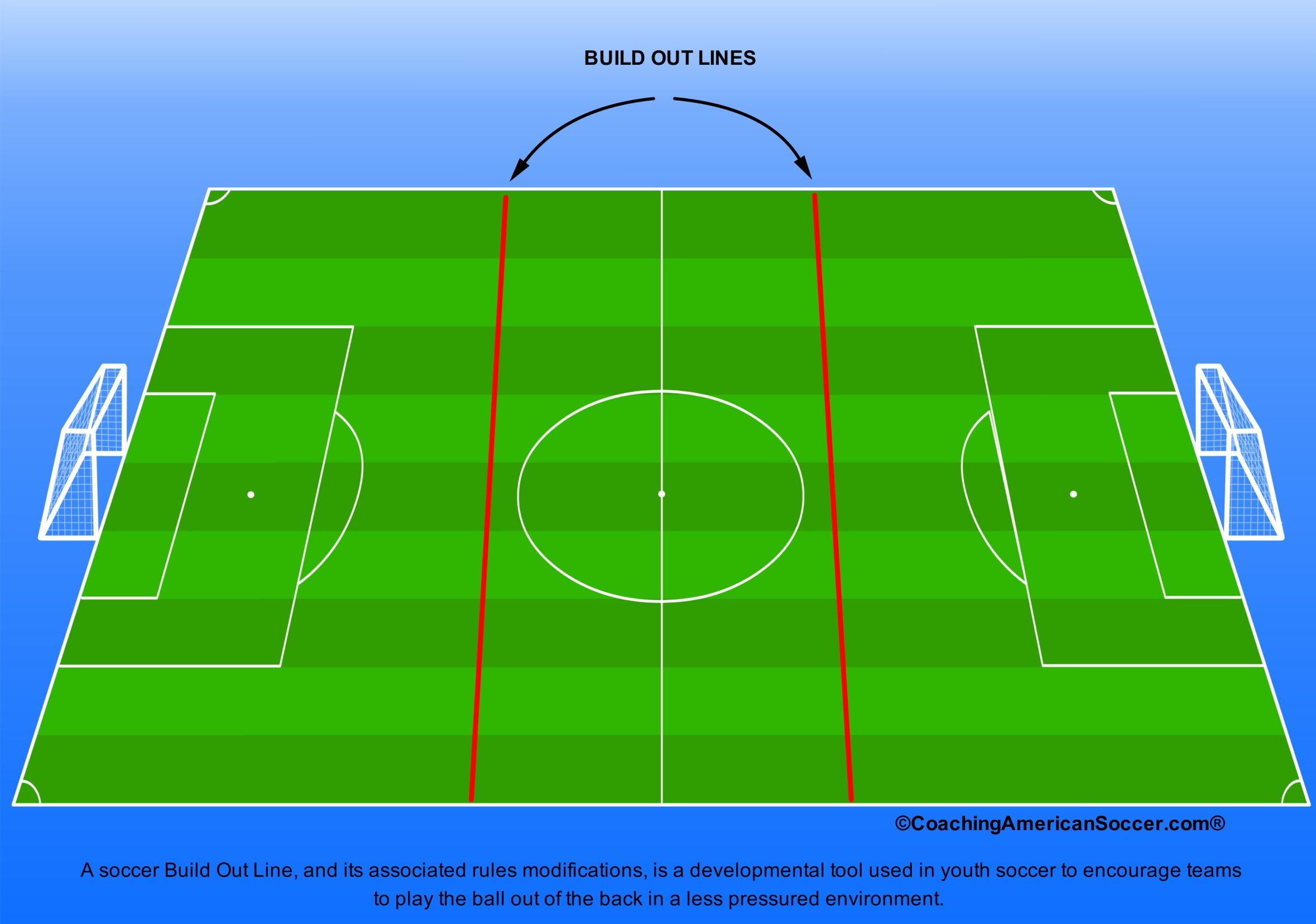
Youth Soccer Build Out Lines
Coaches must teach the reason behind the build out line to their players in addition to the rules associated with its implementation. Building out of the back is a tactical approach where a team starts its attacking phase from within its own defensive third of the field rather than just kicking the ball long. It is a patient, possession-based strategy designed to control the game, draw opposing teams forward, and create space behind them to generate enhanced offensive options.*
The build out line itself is a horizontal line marked across both ends the field, usually positioned equidistant between the top of the penalty area and the halfway line. The use of a build out line requires significant changes to Local Rules, usually applied to small-sided games, 7v7, or for the U8, U9 and U10 age groups.
Rules changes require the defending team to retreat behind the build out line during goal kicks, free kicks, and goalkeeper possession. This promotes playing out from the back, reduces long-ball punting, and acts as an expanded limit for offside positioning.
When the originally defending team obtains a goal kick, a free kick within the Penalty Area, or their goalkeeper has acquired possession of the ball, the opposing team must retreat behind the build out line until a second defender has touched the ball or the ball crosses the build out line. The build out line is also treated as the line where offside can be called instead of the halfway line.
The build out line impacts four specific areas of the game – goal kicks, free kicks, goalkeeper possession, and offside:
Goal Kicks
For the youngest players first starting team play that introduces goal kicks, it is extremely difficult to get the ball into play and away from their own goal without being swarmed by the opponents.
Accordingly, on goal kicks, the opposing team must move behind the build out line before the kick is taken. Because of this requirement, the build out line is sometimes referred to as the “retreat line.” The opposing team may cross the build out line and resume pressure as soon as the ball is “in play.”
The ball is in play once it is kicked and clearly moves. (For detailed explanations of the impact of the build out line on goal kicks, see “Offensive Goal Kicks” and “Defending Goal Kicks”.) A player taking a goal kick does not have to wait for the opposition to retreat. If they choose to kick the ball early, the ball is in play.
Free Kicks
For free kicks, the build out rules that apply are essentially the same as for goal kicks. When the defending team is awarded a free kick anywhere inside the Penalty Area, the opposing team must move behind the build out line before the kick is taken. (If the ball is spotted anywhere else, outside of the Penalty Area but within the build out area, the opposing team must still obey the 10-yard restriction.)
Goalkeeper Possession
When a goalkeeper catches the ball during live play, the opposing team must immediately retreat behind the build out line. The goalkeeper can then pass (by kicking the ball along the ground; not dribbling), throw, or roll the ball to a teammate. Punting and drop-kicking (including bouncing) are prohibited. As usual, goalkeeper possession ends as soon as the ball is released. Like goal kicks, the goalkeeper does not have to wait for the opposition to retreat. If they choose to release the ball early, the ball is in play.
Offside
In youth games that have reached the level of implementing offside, the build out line replaces the halfway line for offside offenses. An attacking player cannot be penalized for offside unless they are between the build-out line and the opponent’s goal line, with all other offside criteria being applicable. This change is designed to create more space in the midfield, preventing players from being packed between the halfway line and the build out line.
INFRACTIONS
An indirect free kick is awarded for technical violations related to the rules associated with the build out lines. The ball is usually placed at the spot of the infraction.
Goal Kicks – Encroachment: If an opponent fails to retreat behind the build-out line or prematurely crosses it to interfere with a goalkeeper’s release or a goal kick, the referee stops play. (Restart: An indirect free kick for the goalkeeper’s team at the spot where the opponent crossed or touched the ball.)
Free Kicks – Encroachment: If an opponent fails to retreat behind the build-out line or prematurely crosses it to interfere with kick, the referee stops play. (Restart: The kick is retaken.)
Goalkeeper Possession – Punting or Drop-Kicking: Goalkeepers are prohibited from punting or drop-kicking the ball. (Restart: An indirect free kick for the opposing team from the spot of the offense. If the infringement occurs inside the Goal Area, the ball is placed on the Goal Area line nearest to the infringement. Option: the ball is placed on the Penalty Area line nearest the infringement.)
Illegal Air Distribution: In some leagues, goal kicks or goalkeeper distributions (throws) may not travel past the halfway line in the air without first touching the ground or a player. (Restart: An indirect free kick for the opposing team where the ball crossed the halfway line.)
Offside – Offside: Same as usual play, but the player is beyond the build out line, in an offside position, and has gained an advantage. (Restart: An indirect free kick is awarded at the spot of the infraction.
REFEREE GUIDANCE
Possession Time: The 8-second rule for goalkeepers usually does not begin until all opponents have retreated past the build-out line.
If a referee determines that actions by a team are intended to circumvent the intent of this rule, a referee may stop play and explain to the coach that their team’s actions are not complying with the spirit and intent of the rule and conduct a restart with the goalkeeper or award an indirect free kick on the build-out line placed closest to where offense occurred, and a coach may be cautioned for Unsporting Behavior.
Examples of not following the intent of the rule include:
- Goalkeepers repeatedly throwing or kicking the ball beyond the build-out line but not directly to a teammate or after a save.
- Goalkeepers putting the ball on the ground and clearing it down field rather than purposely passing the ball to a teammate.
- Opposing team members repeatedly crossing the build-out line early, attempting to delay the game through restarts.
- Opposing team members slow walking or delaying movement toward the build-out line.
- Referees should encourage opponents to move quickly beyond the build-out line.
- Some flexibility should be given to the “8 second clock”, allowing it to start when all opponents have retreated behind the build-out line. But goalkeepers should not be allowed to extend the time by delaying tactics.
- The referee should position themselves on or very close to the build-out line and ask the players to stay behind until the ball is played out.
- In games with Offside calls, ARs should position themselves on or very close to the build-out line when marking Offside calls.
Soccer Coaching Tips:
- The build out line was presented by the U.S. Soccer Player Development Initiative, introduced in 2017.
- The line itself may be dashed or solid.
- The Build Out Line is sometimes abbreviated as “BOL.”
- Referees may prioritize the “spirit of the game” for younger age groups and may allow a retake for accidental punts before awarding an indirect free kick, depending on the specific tournament or league guidelines.
© John C. Harves
*The following expanded information is AI-generated, references unknown.
Philosophy
Building from the back uses short, quick, and intentional passing to maintain control. It transforms the goalkeeper from a mere shot-stopper into the first attacker, and defenders into ball-playing architects.
- Purpose: To force opponents to press high, which leaves space behind their defensive line, and to keep possession to tire out the defense.
- Risk vs. Reward: It is high-risk, high-reward. A mistake in the defensive third often leads directly to an opponent’s goal, but a successful build-up breaks the first line of pressure, opening up the pitch.
The Setup and Mechanics
When the goalkeeper has the ball (e.g., goal kick, free-kick, or open play), the team spreads out to maximize space.
- The Goalkeeper (GK): Acts as an extra outfield player, staying ready to receive passes from defenders, enabling a numerical advantage (e.g., 4 defenders + 1 GK vs. 3 forwards).
- Center-Backs (CBs): Split wide, often to the corners of the penalty box, to open up passing lanes.
- Fullbacks/Wingbacks (FBs): Push high up the pitch, often near the touchlines, stretching the opposing team horizontally.
- The Pivot (Defensive Midfielder – #6): Drops deep between or just in front of the center-backs to create a “diamond” shape at the back, offering a central passing option.
The Progressive Process
- The Initial Pass: The goalkeeper plays a short pass to a center-back or the dropping pivot.
- Attracting Pressure: The defenders deliberately hold the ball, inviting the opponent to press.
- Breaking the Line: As the opposing forward steps up, the ball is passed to a player who has now become “free” because of that movement.
- Creating Triangles: Players form triangles (GK-CB-FB or CB-6-FB) to provide multiple, short-passing options, making it hard to trap the ball.
- Recycling/Switching: If the forward pass is blocked, the ball is passed back to the goalkeeper to switch the attack to the other side of the pitch.
Key Skills and Principles
- Composure: Defenders must remain calm under intense pressure.
- Scanning: Players must constantly look around to identify free spaces and opponents before receiving the ball.
- Body Shape: Players should receive the ball with an “open” body stance, facing forward, allowing them to instantly play a progressive pass.
- Firm Passing: Passes must be firm to prevent interceptions, particularly in the crowded penalty area.
Why It’s Used (The Benefits)
- Control: The team controls the tempo of the game.
- Space Generation: By drawing the opponent’s forwards and midfielders toward their own goal, space opens up in the middle third for midfielders to operate.
- Development: It develops technical ability and comfort on the ball for all players, not just attackers.
- Reduced Turnovers: It is safer than long kicks, which often immediately turn into a 50/50 loss of possession.
Common mistakes include being too static, passing only horizontally, or failing to switch play when the center is too crowded. Successful teams use this method to patiently deconstruct a “low block” (defensive) team.
[Editor’s Note: If the expanded information above is yours, please contact CoachingAmericanSoccer@gmail.com for an appropriate citation.]